
As solar energy adoption continues to grow across residential, commercial, and industrial sectors, one of the most common questions property owners and businesses ask is: Should I choose a Ground Mounting Structure or a rooftop solar system?
Both options offer significant benefits, but the right choice depends on factors such as available space, energy requirements, budget, and future expansion plans. Understanding the differences between these solar installation methods can help you make a more informed investment decision.
In this guide, we’ll compare Solar Ground Mounting Structure solutions and rooftop solar systems to help you determine which option is best for your project.
Understanding Ground-Mounted and Rooftop Solar Systems
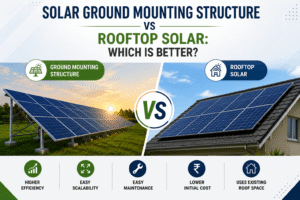
A Ground Mounting Structure is a framework designed to support solar panels installed directly on the ground. These systems are commonly used in commercial facilities, industrial plants, solar farms, and locations with sufficient open land.
On the other hand, rooftop solar systems are installed on the roof of a building and utilize existing roof space to generate electricity.
Both solutions harness solar energy effectively, but their performance and suitability can vary based on project requirements.
Space Availability
One of the biggest differences between the two systems is space utilization.
A Ground Mounting Structure requires open land for installation, making it ideal for industries, commercial properties, agricultural land, and large-scale solar projects.
Rooftop solar systems are better suited for residential homes and buildings where roof space is available but land is limited.
Best Choice:
- Large land area available → Ground-mounted solar
- Limited land but usable roof space → Rooftop solar
Energy Generation Efficiency
The efficiency of a solar system depends largely on panel orientation and tilt angle.
A Ground Mounting Structure provides greater flexibility because solar panels can be positioned at the ideal angle and direction to maximize sunlight exposure throughout the year.
In contrast, rooftop systems are often limited by the roof’s design, orientation, and slope.
As a result, a properly designed Ground Mounting Structure can often generate higher energy output compared to rooftop installations of similar capacity.
Installation and Maintenance
Maintenance accessibility is another important consideration.
A Ground Mounting Structure allows easy access to solar panels for cleaning, inspections, and repairs. Technicians can perform maintenance safely without needing rooftop access equipment.
Rooftop systems may require additional safety measures and can be more difficult to access, especially on large commercial buildings.
Advantages of Ground-Mounted Systems:
- Easier maintenance
- Faster inspections
- Better cleaning accessibility
- Reduced maintenance challenges
Scalability and Future Expansion
Many businesses plan to increase their solar capacity as energy needs grow.
A Ground Mounting Structure offers significant flexibility for future expansion. Additional panels can often be added by utilizing adjacent land without major structural modifications.
Rooftop solar systems are generally limited by available roof space and structural load capacity.
For organizations planning long-term growth, ground-mounted systems often provide a more scalable solution.
Cost Comparison
The initial installation cost of a Ground Mounting Structure is typically higher than rooftop solar because it requires additional structural components, foundations, and site preparation.
However, the long-term benefits can often justify the investment through:
- Higher energy generation
- Easier maintenance
- Longer operational efficiency
- Greater scalability
Rooftop systems generally have lower upfront costs because they utilize an existing structure.
Durability and Performance
Weather conditions can significantly impact solar installations.
A high-quality Ground Mounting Structure is engineered to withstand wind loads, rain, temperature variations, and other environmental factors. These structures are designed for long-term durability and operational reliability.
Modern rooftop systems are also durable, but their performance may be influenced by roof conditions and structural limitations.
Benefits of a Ground Mounting Structure for Solar Panels
A well-designed ground mounting structure for solar panels offers several advantages:
- Optimal panel orientation
- Improved energy generation
- Easier maintenance access
- Better scalability
- Reduced shading issues
- Enhanced system lifespan
These benefits make ground-mounted systems particularly attractive for commercial and industrial solar projects.
When Should You Choose a Solar Ground Mounting System?
A solar ground mounting system is often the best choice when:
- Large open land is available
- High energy generation is required
- Future expansion is planned
- Rooftop space is insufficient
- Maximum system efficiency is a priority
Industries, warehouses, manufacturing facilities, and solar farms frequently choose ground-mounted solutions because of their flexibility and long-term performance advantages.
When Should You Choose Rooftop Solar?
Rooftop solar may be a better option if:
- Roof space is available
- Land is limited
- Energy requirements are moderate
- Lower upfront investment is preferred
- Residential installation is the primary objective
For many homes and small businesses, rooftop solar remains a practical and cost-effective solution.
How the Right Solar Solution Impacts ROI
Whether you choose a rooftop system or a Ground Mounting Structure, the goal is to maximize return on investment.
A properly engineered solar ground mounting system can increase energy production, reduce operational costs, and support future capacity expansion. Over time, these advantages can lead to greater financial returns and improved energy independence.
Choosing the right system depends on balancing available space, budget, and long-term energy goals.
Why Partner with an Experienced Solar EPC Company?
Selecting the right solar solution requires technical expertise, proper planning, and quality execution.
Tech Sun Bio is a trusted solar project developer and EPC company delivering rooftop, commercial, industrial, and ground-mounted solar solutions. Founded in 2014 by IIT Bombay alumnus Tejas Patel, the company combines technical expertise with end-to-end project execution to help homes and businesses adopt reliable, efficient, and sustainable solar energy solutions.
From site assessment and engineering to installation and maintenance, Tech Sun Bio helps clients choose the most suitable Ground Mounting Structure or rooftop solar system based on their specific energy requirements and project goals.
Conclusion
When comparing a Ground Mounting Structure and rooftop solar, there is no one-size-fits-all answer. The best option depends on your available space, energy consumption, budget, and future expansion plans.
A Ground Mounting Structure offers greater flexibility, higher energy generation potential, easier maintenance, and better scalability, making it ideal for commercial and industrial projects. Rooftop solar systems remain an excellent choice for homes and businesses with limited land and suitable roof space.
By working with an experienced solar EPC partner like Tech Sun Bio, you can evaluate your requirements and select the solar solution that delivers the highest efficiency, reliability, and long-term value.
FAQs
1. What is a Ground Mounting Structure in solar projects?
A Ground Mounting Structure is a framework that supports solar panels installed on the ground, providing stability, durability, and optimal panel positioning.
2. Which is better: Ground Mounting Structure or rooftop solar?
It depends on your project requirements. A Ground Mounting Structure is ideal for larger installations and higher energy generation, while rooftop solar is suitable where roof space is available.
3. What are the benefits of a Ground Mounting Structure for solar panels?
A Ground Mounting Structure for solar panels offers better panel orientation, easier maintenance, higher efficiency, and flexibility for future expansion.
4. Is a solar ground mounting system more efficient than rooftop solar?
Yes, a solar ground mounting system can often generate more electricity because panels can be installed at the optimal tilt angle and direction for maximum sunlight exposure.
5. How long does a Ground Mounting Structure last?
A high-quality Ground Mounting Structure made from galvanized steel or durable materials can last 25 years or more with proper maintenance.