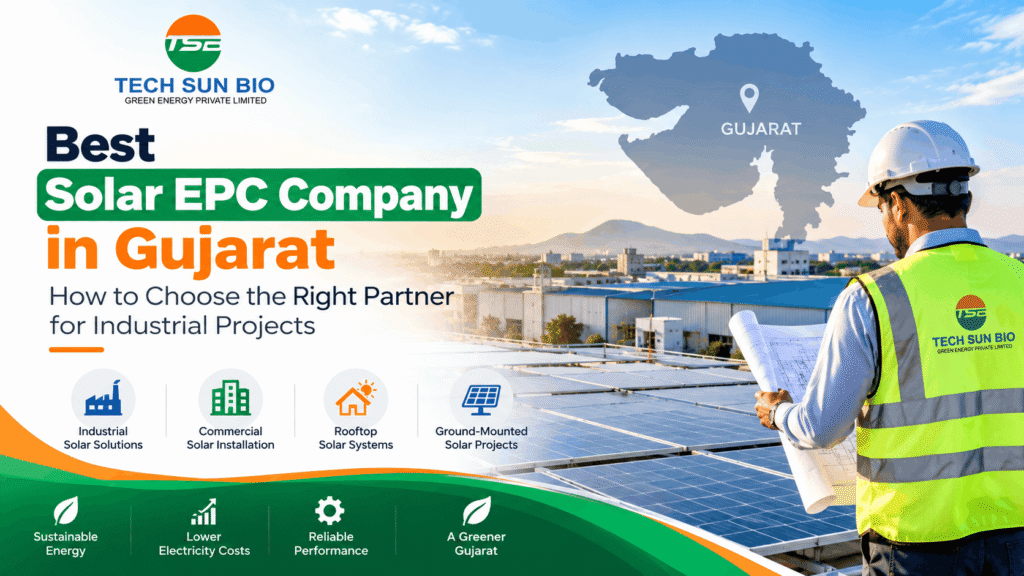
Best Solar EPC Company in Gujarat: How to Choose the Right Partner for Industrial Projects
Choosing the right solar partner is an important decision for businesses planning to invest in solar energy. For industrial companies, a well-planned solar project can help manage electricity expenses, improve energy efficiency, and support long-term sustainability goals. However, the results depend on the system design, equipment quality, installation, and ongoing maintenance. If you are searching for the Best Solar EPC Company in Gujarat, it is important to look beyond the initial quotation. You need a partner who understands your energy requirements, evaluates your site properly, and manages the project with a clear execution plan. Tech Sun Bio is a solar project developer and EPC company founded in 2014 by IIT Bombay alumnus Tejas Patel. The company provides rooftop, commercial, industrial, and ground-mounted solar solutions for customers exploring reliable and sustainable energy options. What Does a Solar EPC Company Do? EPC stands for Engineering, Procurement, and Construction. A solar EPC company manages the technical planning, equipment procurement, and installation of a solar power system according to the agreed project scope. A professional Solar EPC Company in Gujarat can help businesses with site assessment, system design, equipment selection, installation coordination, testing, and commissioning. Before selecting a provider, ask what services are included in the quotation. Confirm the project timeline, equipment specifications, warranty coverage, safety requirements, and responsibilities after installation. Understanding these details helps you compare proposals more effectively. How to Choose the Best Solar EPC Company in Gujarat Selecting a solar partner requires careful research. The following factors can help you make a more informed decision. 1. Check Experience and Previous Projects Start by reviewing the company’s experience and completed projects. Look for installations similar to your own in terms of industry, system capacity, and site conditions. Ask for genuine project photographs, technical details, and customer references where available. These details can help you understand the company’s practical capabilities rather than relying only on marketing claims. When comparing the Best Solar EPC Company in Gujarat options, consider technical knowledge, project execution, and the ability to address challenges throughout the installation process. 2. Understand Your Industrial Energy Requirements Every industrial facility has different electricity consumption patterns. A manufacturing unit operating throughout the day may have different requirements from a warehouse or a facility with seasonal production. A reliable solar partner should assess your electricity bills, connected load, operating hours, available roof or land area, and existing electrical infrastructure before recommending a system. An experienced Industrial Solar Company in Gujarat should also explain whether rooftop or ground-mounted solar is more suitable for your property. 3. Compare Equipment Quality and System Design Solar panels, inverters, mounting structures, cables, and electrical protection systems all contribute to the performance and safety of a solar installation. Do not select a system based only on the lowest price. Compare equipment specifications, product warranties, installation standards, monitoring facilities, and estimated energy generation. The right design should consider shading, roof strength, site conditions, electricity consumption, and future maintenance requirements. 4. Evaluate Project Management and Installation Support Solar projects involve several stages, including engineering, procurement, installation, testing, and commissioning. Poor coordination can cause delays or create avoidable problems. A dependable Solar Installation Company in Gujarat should provide a clear project schedule, explain the installation process, and communicate any site-related challenges before work begins. For industrial facilities, the team should also plan installation activities carefully to minimise disruption to regular business operations. Commercial and Industrial Solar Solutions in Gujarat Solar energy can serve different business requirements, but the solution must match the property’s energy needs and available space. Commercial Solar Installation in Gujarat Offices, warehouses, hotels, educational institutions, and other commercial properties may benefit from appropriately designed rooftop solar systems. A professional Commercial Solar Installation in Gujarat assessment should consider usable roof space, structural suitability, shading, daytime electricity consumption, and grid-connection requirements. Businesses should also compare the total project cost with expected electricity savings. Actual savings depend on system generation, electricity tariffs, applicable utility rules, financing costs, and consumption patterns. Industrial Solar Projects Industrial solar installations require careful planning because factories and manufacturing units may have high electricity demand and complex electrical infrastructure. An experienced Industrial Solar Company in Gujarat should evaluate site conditions, load requirements, structural safety, equipment specifications, and project execution before finalising the design. For businesses with sufficient open land, ground-mounted solar may be another option. The choice between rooftop and ground-mounted systems depends on available space, project capacity, site conditions, and financial objectives. Why Consider Tech Sun Bio for Your Solar Project? Tech Sun Bio brings solar industry experience and end-to-end project execution capabilities to residential, commercial, and industrial applications. Founded in 2014 by IIT Bombay alumnus Tejas Patel, the company works across rooftop and ground-mounted solar solutions. As a Solar Project Developer in Gujarat, a company’s responsibilities may extend beyond installation to project planning, technical coordination, and execution. Businesses should confirm the exact services offered for their individual project. Tech Sun Bio can be considered by customers evaluating solar solutions for their properties and business operations. You can explore the company’s solar solutions and review its projects to learn more about its offerings. Before proceeding, request a site assessment and a detailed proposal covering system capacity, equipment, estimated generation, project costs, warranties, and maintenance arrangements. Common Mistakes to Avoid When Selecting a Solar Partner Avoiding a few common mistakes can make the decision easier: Choosing a provider based only on the lowest quotation. Ignoring equipment specifications and warranty conditions. Accepting estimated savings without reviewing the assumptions. Overlooking structural checks and electrical safety. Failing to clarify maintenance responsibilities and post-installation support. A good comparison should consider the overall project value, not just the initial investment. Frequently Asked Questions 1. How do I choose the Best Solar EPC Company in Gujarat? Compare relevant project experience, engineering capabilities, equipment quality, installation standards, project timelines, warranties, and after-sales support. 2. What services does a Solar EPC Company in Gujarat provide? Depending on the contract, services may include engineering, equipment procurement, construction, installation, testing, and commissioning. 3. Is commercial solar installation suitable