
techsunbio.com

ground mounted solar power plant

ground-mounting-structure
Solar Panel

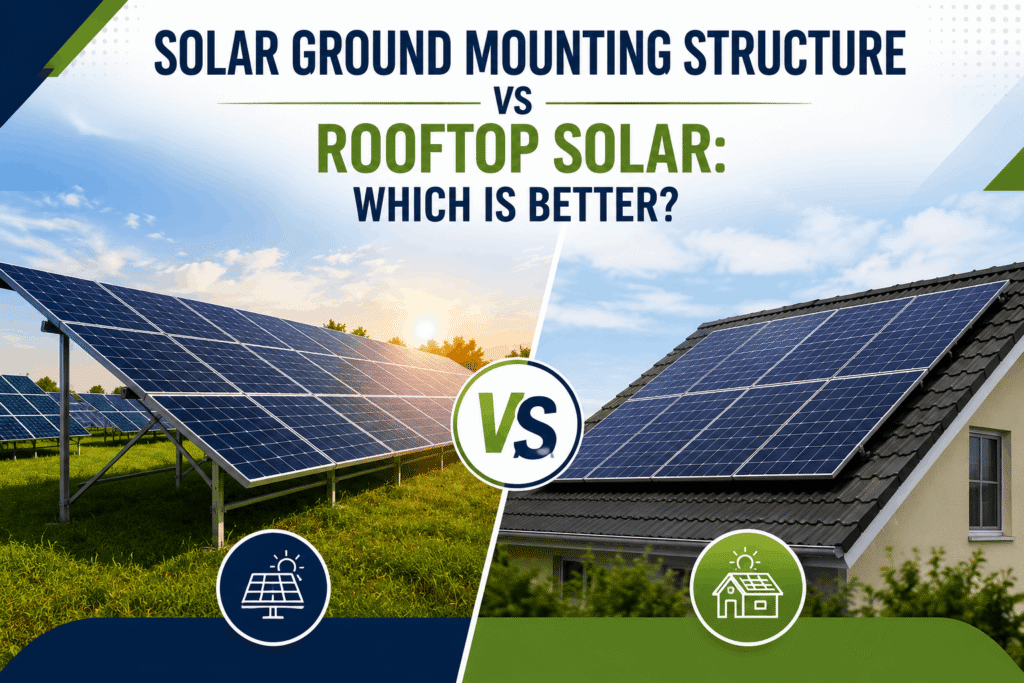
Solar Ground Mounting Structure vs Rooftop Solar: Which Is Better?

As solar energy adoption continues to grow across residential, commercial, and industrial sectors, one of the most common questions property owners and businesses ask is: Should I choose a Ground Mounting Structure or a rooftop solar system? Both options offer significant benefits, but the right choice depends on factors such as available space, energy requirements, budget, and future expansion plans. Understanding the differences between these solar installation methods can help you make a more informed investment decision. In this guide, we’ll compare Solar Ground Mounting Structure solutions and rooftop solar systems to help you determine which option is best for your project. Understanding Ground-Mounted and Rooftop Solar Systems A Ground Mounting Structure is a framework designed to support solar panels installed directly on the ground. These systems are commonly used in commercial facilities, industrial plants, solar farms, and locations with sufficient open land. On the other hand, rooftop solar systems are installed on the roof of a building and utilize existing roof space to generate electricity. Both solutions harness solar energy effectively, but their performance and suitability can vary based on project requirements. Space Availability One of the biggest differences between the two systems is space utilization. A Ground Mounting Structure requires open land for installation, making it ideal for industries, commercial properties, agricultural land, and large-scale solar projects. Rooftop solar systems are better suited for residential homes and buildings where roof space is available but land is limited. Best Choice: Large land area available → Ground-mounted solar Limited land but usable roof space → Rooftop solar Energy Generation Efficiency The efficiency of a solar system depends largely on panel orientation and tilt angle. A Ground Mounting Structure provides greater flexibility because solar panels can be positioned at the ideal angle and direction to maximize sunlight exposure throughout the year. In contrast, rooftop systems are often limited by the roof’s design, orientation, and slope. As a result, a properly designed Ground Mounting Structure can often generate higher energy output compared to rooftop installations of similar capacity. Installation and Maintenance Maintenance accessibility is another important consideration. A Ground Mounting Structure allows easy access to solar panels for cleaning, inspections, and repairs. Technicians can perform maintenance safely without needing rooftop access equipment. Rooftop systems may require additional safety measures and can be more difficult to access, especially on large commercial buildings. Advantages of Ground-Mounted Systems: Easier maintenance Faster inspections Better cleaning accessibility Reduced maintenance challenges Scalability and Future Expansion Many businesses plan to increase their solar capacity as energy needs grow. A Ground Mounting Structure offers significant flexibility for future expansion. Additional panels can often be added by utilizing adjacent land without major structural modifications. Rooftop solar systems are generally limited by available roof space and structural load capacity. For organizations planning long-term growth, ground-mounted systems often provide a more scalable solution. Cost Comparison The initial installation cost of a Ground Mounting Structure is typically higher than rooftop solar because it requires additional structural components, foundations, and site preparation. However, the long-term benefits can often justify the investment through: Higher energy generation Easier maintenance Longer operational efficiency Greater scalability Rooftop systems generally have lower upfront costs because they utilize an existing structure. Durability and Performance Weather conditions can significantly impact solar installations. A high-quality Ground Mounting Structure is engineered to withstand wind loads, rain, temperature variations, and other environmental factors. These structures are designed for long-term durability and operational reliability. Modern rooftop systems are also durable, but their performance may be influenced by roof conditions and structural limitations. Benefits of a Ground Mounting Structure for Solar Panels A well-designed ground mounting structure for solar panels offers several advantages: Optimal panel orientation Improved energy generation Easier maintenance access Better scalability Reduced shading issues Enhanced system lifespan These benefits make ground-mounted systems particularly attractive for commercial and industrial solar projects. When Should You Choose a Solar Ground Mounting System? A solar ground mounting system is often the best choice when: Large open land is available High energy generation is required Future expansion is planned Rooftop space is insufficient Maximum system efficiency is a priority Industries, warehouses, manufacturing facilities, and solar farms frequently choose ground-mounted solutions because of their flexibility and long-term performance advantages. When Should You Choose Rooftop Solar? Rooftop solar may be a better option if: Roof space is available Land is limited Energy requirements are moderate Lower upfront investment is preferred Residential installation is the primary objective For many homes and small businesses, rooftop solar remains a practical and cost-effective solution. How the Right Solar Solution Impacts ROI Whether you choose a rooftop system or a Ground Mounting Structure, the goal is to maximize return on investment. A properly engineered solar ground mounting system can increase energy production, reduce operational costs, and support future capacity expansion. Over time, these advantages can lead to greater financial returns and improved energy independence. Choosing the right system depends on balancing available space, budget, and long-term energy goals. Why Partner with an Experienced Solar EPC Company? Selecting the right solar solution requires technical expertise, proper planning, and quality execution. Tech Sun Bio is a trusted solar project developer and EPC company delivering rooftop, commercial, industrial, and ground-mounted solar solutions. Founded in 2014 by IIT Bombay alumnus Tejas Patel, the company combines technical expertise with end-to-end project execution to help homes and businesses adopt reliable, efficient, and sustainable solar energy solutions. From site assessment and engineering to installation and maintenance, Tech Sun Bio helps clients choose the most suitable Ground Mounting Structure or rooftop solar system based on their specific energy requirements and project goals. Conclusion When comparing a Ground Mounting Structure and rooftop solar, there is no one-size-fits-all answer. The best option depends on your available space, energy consumption, budget, and future expansion plans. A Ground Mounting Structure offers greater flexibility, higher energy generation potential, easier maintenance, and better scalability, making it ideal for commercial and industrial projects. Rooftop solar systems remain an excellent choice for homes and businesses with limited land and suitable roof
ground-mounted-solar project
Solar Panel

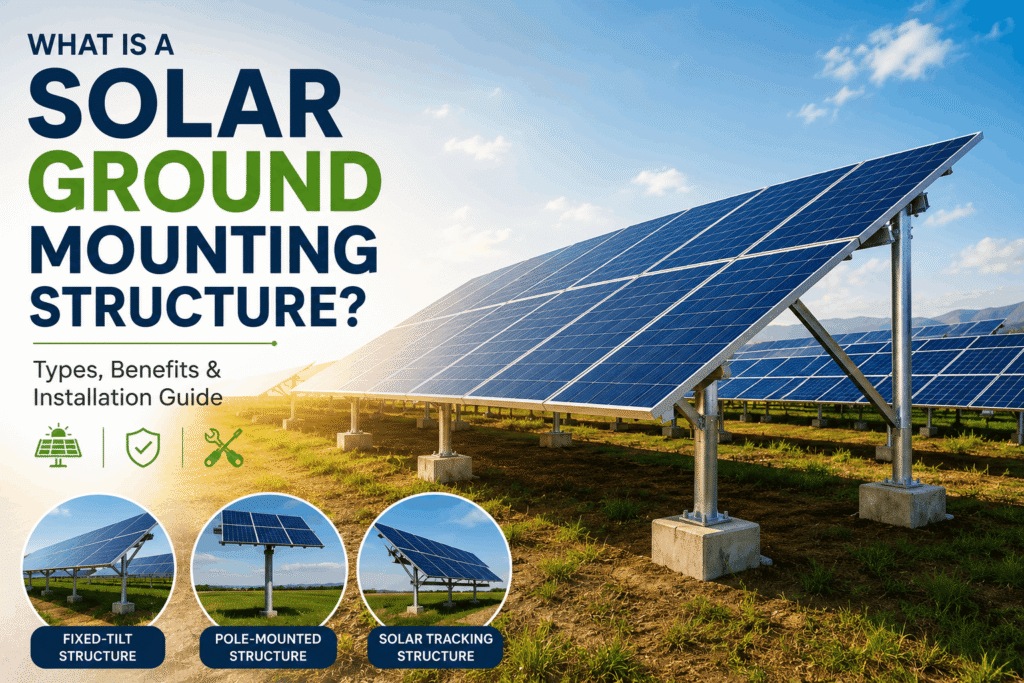
What Is a Solar Ground Mounting Structure? Types, Benefits & Installation Guide

Solar energy is no longer limited to rooftops. For industries, businesses, farms, and utility-scale projects with sufficient open land, ground-based solar installations offer greater flexibility in system size, panel orientation, and maintenance. At the heart of these installations is a Solar Ground Mounting Structure, an engineered framework designed to securely position solar panels above the ground. A well-designed structure does more than hold solar panels. It helps maintain the required tilt, withstand environmental conditions, and provide convenient access for maintenance. This makes structure selection an important engineering decision for any ground mount solar installation. What Is a Solar Ground Mounting Structure? A Solar Ground Mounting Structure is a support system used to install photovoltaic panels directly on land instead of a building rooftop. Depending on site and engineering requirements, these structures can be secured using driven piles, concrete foundations, ground screws, or other suitable foundation systems. They are commonly used for industrial plants, solar parks, institutional campuses, farms, and large commercial projects where sufficient land is available. For a ground mounted solar project gujarat, factors such as soil conditions, wind load, drainage, terrain, project capacity, and accessibility should be carefully evaluated before the final structure and layout are selected. Unlike rooftop installations, ground mount solar systems generally provide greater flexibility in deciding module orientation, row spacing, tilt angle, and overall plant layout. Types of Solar Ground Mounting Structures The right Solar Ground Mounting Structure depends on land conditions, project capacity, engineering requirements, budget, and expected power generation. 1. Fixed-Tilt Structure Fixed-tilt systems keep solar modules at a predetermined angle throughout the year. Their relatively straightforward design and maintenance requirements make them a common choice for commercial and large-scale solar projects. 2. Pole-Mounted Structure In this system, solar panels are installed on poles anchored into the ground. Pole-mounted systems can be suitable for selected smaller projects or locations where panels need additional elevation. 3. Solar Tracking Structure Solar trackers allow panels to move according to the sun’s position. They can improve energy capture under suitable conditions but involve additional mechanical components, engineering, investment, and maintenance. The best option for a ground mount solar project should therefore be selected based on lifecycle performance rather than installation cost alone. Main Components of a Ground Mounting Structure A typical ground-mounted system consists of foundations, vertical posts, beams, rails, bracing, clamps, fasteners, and module-supporting components. Material selection is also important because these structures remain exposed to outdoor conditions for many years. Galvanized steel, aluminium, and other corrosion-resistant materials may be used depending on structural and environmental requirements. For a ground mounted solar project gujarat, professional site assessment becomes especially important because soil characteristics, terrain, wind conditions, and environmental exposure can vary from one location to another. Benefits of Ground-Mounted Solar A properly engineered Solar Ground Mounting Structure can provide several practical benefits. Greater design flexibility: Open land gives engineers more freedom to determine panel orientation, tilt, and row spacing. Scalability: A ground mount solar system can support different project capacities and may allow future expansion where land and grid conditions permit. Easy maintenance access: Ground-level installations can make panels and structural components easier for technicians to inspect and maintain. No dependency on rooftop condition: The system does not rely on a building’s roof area or structural capacity. Suitable for large projects: Ground-mounted installations are particularly useful when the required solar capacity cannot be accommodated on available rooftop space. Solar Ground Mounting Structure Installation Process Installing a Solar Ground Mounting Structure involves much more than placing panels on open land. A professional installation typically follows several stages. Site assessment: Engineers evaluate land availability, shading, terrain, access, drainage, and other project constraints. Survey and soil investigation: Topographical and geotechnical assessments help determine suitable foundations and structural requirements. Engineering and layout: Engineers finalize module orientation, row spacing, tilt angle, structural loads, and foundation positions. Foundation installation: Depending on the design, driven piles, concrete foundations, or ground screws may be installed. Structure assembly: Posts, beams, rails, and supporting members are installed according to approved engineering drawings. Module and electrical installation: Solar panels are mounted, followed by cabling, inverters, electrical equipment, and other balance-of-system components. Testing and commissioning: The complete solar plant is inspected and tested before commercial operation. For a ground mounted solar project gujarat, working with an experienced EPC team can help ensure that structural, civil, and electrical requirements are coordinated throughout execution. Factors to Consider Before Choosing a Structure Not every Solar Ground Mounting Structure is suitable for every project. Project owners should consider soil characteristics, wind conditions, corrosion exposure, land slope, drainage, module dimensions, maintenance access, project capacity, and applicable engineering standards. The economics of ground mount solar should also be evaluated at the complete project level. Choosing the lowest-cost structure may not deliver the best long-term outcome if durability, safety, maintenance, or performance is compromised. Why Professional Solar EPC Expertise Matters Ground-mounted solar requires coordination between site planning, civil works, structural engineering, electrical design, installation, safety, testing, and commissioning. Tech Sun Bio is a trusted solar project developer and EPC company delivering rooftop, commercial, industrial, and ground-mounted solar solutions. Founded in 2014 by IIT Bombay alumnus Tejas Patel, the company combines technical expertise with end-to-end project execution to help businesses adopt reliable and sustainable solar energy. For organizations evaluating a ground mounted solar project gujarat, an experienced EPC partner can help turn site-specific requirements into a properly engineered and efficiently executed solar project. Conclusion A Solar Ground Mounting Structure forms the physical foundation of a reliable ground-based solar installation. The ideal solution depends on project size, land characteristics, environmental conditions, structural requirements, maintenance needs, and long-term energy objectives. Whether a project uses a fixed-tilt or tracking system, careful engineering and quality installation remain essential. For businesses planning a ground mounted solar project gujarat, evaluating the complete project requirements before selecting the structure can support safer execution, easier maintenance, and dependable long-term solar performance. FAQs 1. Is ground-mounted solar right for my property? It can be a good choice if you have sufficient open, shadow-free

Scroll to Top